
How Easy Is It to Install an Adjustable Pressure Pump Controller Yourself?
Zhejiang Huaxi Electronics Co., Ltd, through its Adjustable Pressure Pump Controller, reflects how modern water system control is becoming simpler, safer, and more accessible for everyday installation scenarios. Across homes, farms, and industrial setups, pressure control is no longer limited to complex engineering work.
For years, water supply systems relied heavily on manual adjustment or bulky control equipment that required specialized handling. Today, compact intelligent controllers are changing that experience. Among them, the Pressure Pump Controller has gained attention for its ability to combine pressure regulation, protection functions, and automated operation into a single compact device.
This shift raises a practical question for many users working with pumps in real environments: how easy is it to install and set up such a device without advanced technical support?
Why Installation Simplicity Matters in Modern Pump Systems
Water systems are used in a wide range of environments—from agricultural irrigation fields to residential water tanks and industrial pipelines. In many of these scenarios, downtime or complex installation processes can cause operational inconvenience.
The Pressure Pump Controller is designed to reduce that friction. Instead of relying on manual switching or separate protection devices, the controller integrates multiple functions into a single unit, reducing wiring complexity and setup steps.
Common installation challenges in traditional systems
Before compact controllers became widely used, typical issues included:
- Multiple external relays and switches
- Separate pressure sensing components
- Manual calibration of pressure limits
- Higher risk of wiring errors
- Difficulty in troubleshooting faults
These factors often made installation time-consuming, especially in systems that required quick deployment or frequent adjustments.
What Makes Installation Easier in This Type of Controller
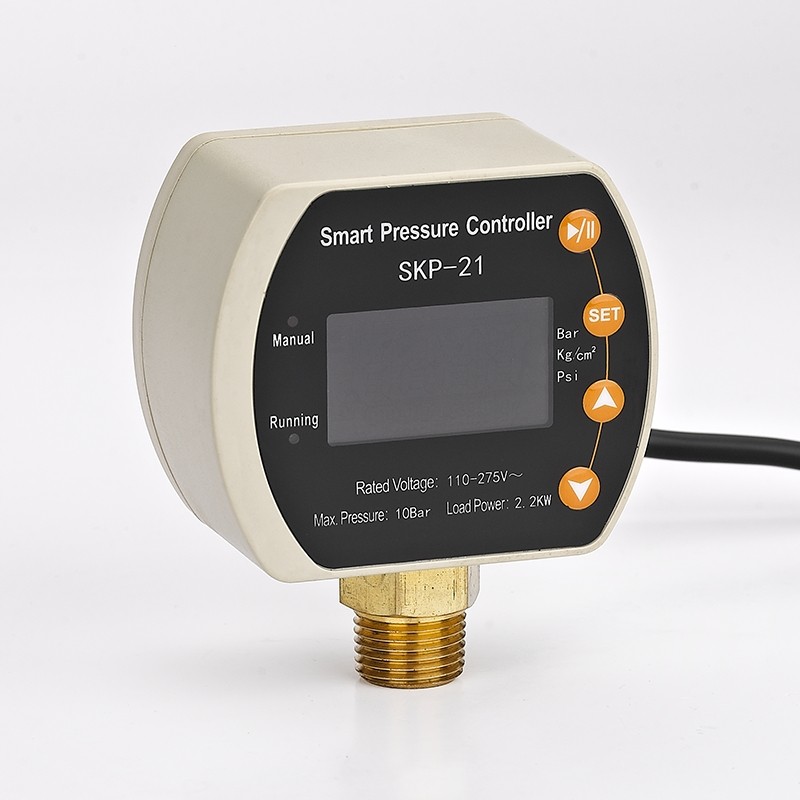
Modern designs focus on simplifying connection points and reducing configuration steps. The SKP-21 Adjustable Pressure Pump Controller reflects this approach through its integrated structure and simplified interface.
Key design elements supporting easy setup
| Feature | Practical impact during installation |
| Integrated pressure sensor | Reduces need for external sensor mounting |
| Wiring/socket output options | Flexible connection to different pump setups |
| Pre-programmed protection logic | Limits need for manual parameter setup |
| Compact shell design (98×86×50mm) | Easier placement in tight control boxes |
| Standard threaded interfaces (G1/2, G1/4) | Simplifies mechanical connection |
These structural choices help reduce the number of steps required during installation and allow the system to be configured in a more straightforward manner.
Step-by-Step Installation Flow in Real Applications
Although installation environments vary, most setups follow a similar logic. The process below reflects a typical field configuration.
1. Positioning the controller
The device is usually mounted near the pump or control cabinet. Its compact size allows flexible placement without requiring additional structural modifications.
2. Connecting the pipeline interface
Using standard threaded joints (G1/2 or G1/4), the controller is connected to the water system pipeline. This allows it to sense pressure changes directly from the system flow.
3. Electrical connection
Depending on the system design, wiring output or socket output is selected. The working voltage range (110–275VAC) supports various power environments commonly found in residential and industrial setups.
4. System initialization
Once power is connected, the controller begins monitoring pressure levels automatically. No complex calibration process is required in most standard applications.
5. Functional verification
After installation, the system is typically tested for:
- Automatic start/stop response
- Pressure stability
- Protection activation under dry-run conditions
- Overload response behavior
Why Protection Functions Influence Installation Confidence
Installation is not only about physical setup—it is also about system reliability after activation. One of the reasons adjustable controllers are widely adopted is the integration of protective logic.
The SKP-21 Adjustable Pressure Pump Controller includes:
- Water shortage protection
- Overload protection
- Automatic shutdown behavior under abnormal conditions
- Fault alarm response
These functions reduce the need for additional external safety modules, simplifying both installation planning and long-term maintenance structure.
Pressure Control Behavior in Real Use Scenarios
Different applications require different pressure stability patterns. A single system may be used across irrigation, heating circulation, or household supply.
Typical application scenarios
- Constant pressure water supply systems
- Agricultural irrigation pipelines
- Boiler and heating circulation systems
- Industrial cooling and fluid transfer
- Building water tank systems
Each scenario requires stable pressure response, especially during sudden demand changes.
Comparison of operating behaviors
| Scenario | Pressure fluctuation risk | Controller response role |
| Water tank supply | Medium | Stabilizes start/stop cycles |
| Irrigation systems | High | Prevents dry-running damage |
| Industrial pipelines | Medium-high | Maintains continuous flow stability |
| Domestic supply | Low-medium | Ensures consistent pressure delivery |
In all these cases, automatic pressure sensing reduces manual intervention during operation.
How Sensor Design Impacts Ease of Setup
One of the most critical components inside an Adjustable Pressure Pump Controller is the pressure sensor. In the SKP-21 model, a diffused silicon oil-filled sensor is used, which improves stability and environmental resistance.
Why this matters during installation:
- Reduces recalibration frequency
- Minimizes sensitivity to vibration
- Improves tolerance in freezing or humid environments
- Supports stable pressure reading during startup
In practical terms, installers spend less time correcting sensor-related inconsistencies after system activation.
Technical Factors That Affect Installation Time
Even when a controller is designed for simplicity, real-world installation speed depends on several technical parameters:
| Factor | Influence on installation |
| Voltage compatibility | Determines whether additional converters are needed |
| Pipe thread standard | Affects mechanical fitting time |
| Control logic preset | Reduces configuration steps |
| Protection integration | Eliminates external safety wiring |
| Housing design | Impacts mounting flexibility |
When these elements are aligned, setup becomes more predictable and less dependent on trial-and-error adjustments.
Real-World Observations from Field Use
In practical environments, users often prioritize stability over complexity. Systems that require fewer manual adjustments tend to perform more consistently over time.
In irrigation systems, for example, automatic start/stop behavior reduces the need for constant monitoring. In residential water systems, pressure consistency improves user experience without frequent manual intervention. In industrial environments, built-in overload protection helps reduce unexpected shutdown events.
These outcomes are not just technical advantages—they directly influence how easily a system can be installed and trusted during operation.
Installation simplicity in modern water control systems is no longer defined only by wiring steps, but by how much intelligence is built into the device itself. The Adjustable Pressure Pump Controller SKP-21 from Zhejiang Huaxi Electronics Co., Ltd demonstrates how integrated sensing, protection logic, and standardized interfaces can streamline setup across different water applications.
By reducing external components and simplifying configuration steps, it offers a more straightforward installation experience while maintaining stable pressure regulation in diverse environments.